The Medium-Rare Litmus Test: How a Steakhouse Shows Its Hand at 130°F
The First Cut Is the Deepest (and Most Thermally Revealing)
I’ve walked into steakhouses that smelled of money, mahogany, and ambition, and I’ve walked out forty-five minutes later knowing, with a quiet certainty, that the kitchen had no idea what it was doing. The giveaway is never the wine list, the lighting, or the pedigree printed on the menu. The giveaway is medium-rare. Specifically, how a steakhouse handles the request for medium-rare—the most ordered, most argued-about, and most misunderstood temperature in the whole canon of meat cookery. If a restaurant can’t deliver a consistent, center-pink, warm-red, 130–135°F internal temperature on a strip, ribeye, or filet, then the marble counters and the dry-aged boasts mean nothing. They’re selling theater, not steak.
I’m Dr. Mike Harmon. I hold a doctorate in meat science, which means I’ve logged more hours with thermocouples and myoglobin than most people spend with their in-laws. I’ve taught slaughterhouse sanitation, judged carcass competitions, and calibrated more Thermapens than I can count. When I sit down at a white-tablecloth steakhouse, I don’t order medium-rare because I like the sound of it. I order it because it’s a precise thermal target that separates the pros from the pretenders. This article walks you through exactly how I size up a steakhouse based on that single temperature request—and why you should, too.

The Thermal Definition of Medium-Rare: 130–135°F Isn’t a Suggestion
Let’s start with the numbers, because without them we’re just waving our hands over a hot plate. Medium-rare, as defined by the culinary textbooks and every serious meat scientist I know, is an internal temperature of 130–135°F (54–57°C) at the moment the steak leaves the heat source. Carryover cooking will usually push the center another 3–5°F during the rest, so a kitchen aiming for a true medium-rare will pull the steak at 125–128°F and let it coast to perfection. The result is a warm, red-pink center that’s firm but not tight, with visible moisture and a texture that yields to the tooth without a fight.
Anything below 125°F in the center is rare—cool, soft, and often still raw-tasting in the very middle. Above 140°F, you’ve entered medium territory, where the myoglobin starts to denature more aggressively, the muscle fibers squeeze out moisture, and the steak begins its sad march toward grayness. A steakhouse that serves you a “medium-rare” steak at 118°F is either lying, incompetent, or hoping you won’t notice. A steakhouse that serves you one at 145°F is overcooking out of fear. Both are failures of the same basic kind: they don’t control their fire.
Why Temperature, Not Color, Is the Only Honest Metric
Plenty of diners judge doneness by cutting into the steak and eyeballing the color. This is a mistake I’ve watched lead to arguments between guests and servers, and it’s a mistake steakhouses exploit. The color of cooked meat is influenced by pH, aging, exposure to oxygen, and even the lighting in the dining room. A high-pH, dark-cutting beef can look almost purple at 135°F, while a well-aged, low-pH steak can appear brownish-pink at the same temperature. I’ve measured steaks that looked medium-well to the eye but read 132°F on a calibrated probe. The eye lies. The thermocouple doesn’t.
When I evaluate a steakhouse, I carry a Thermapen Mk4. I don’t hide it. I’m not a spy; I’m a paying customer with a professional interest. I cut into the thickest part of the steak, insert the probe tip into the thermal center, and wait for the reading to settle. If the server or manager approaches with concern, I explain exactly what I’m doing. Their reaction to this is itself a data point. The best houses nod and say, “We aim for 132°F after rest.” The worst houses tell me I’m ruining the experience. The experience, for me, is the temperature.

The Ordering Moment: How the Server Reacts to “Medium-Rare”
Before any heat touches a steak, the evaluation starts with the server. I order medium-rare without elaboration. I don’t say “warm pink center” or “no blood” or any of the other phrases that mark a diner as anxious. I simply say, “I’ll have the ribeye, medium-rare.” Then I watch.
A well-trained server in a serious steakhouse will either nod and move on, or ask a single clarifying question: “Our medium-rare is a warm red center, is that what you’re after?” That question tells me the kitchen has a standard and the front-of-house knows it. A poorly trained server will ask, “Are you sure? Most people mean medium when they say that.” This is a red flag the size of a tablecloth. It means the kitchen routinely overcooks medium-rare because customers complain about “blood” (which is not blood, it’s myoglobin, and I will die on this hill). It means the house has surrendered to the lowest common denominator of diner ignorance. I don’t eat at those houses twice.
The “Pink or No Pink” Interrogation: A Sign of a Kitchen Without Conviction
Some servers pull out a laminated doneness chart or describe medium-rare as “a little pink in the middle.” This is a disaster. A little pink in the middle is medium, or worse, an unevenly cooked steak with a pink bullseye surrounded by gray bands. A proper medium-rare is pink wall-to-wall, with only the seared crust showing brown. If the server can’t articulate that, the kitchen probably can’t produce it. I’ve collected data on this: in 47 steakhouse visits over three years, the presence of a laminated doneness chart correlated with a 78% failure rate on medium-rare delivery (defined as an internal temperature outside the 130–135°F window). The absence of such a chart correlated with a 91% success rate. The chart is a crutch for a kitchen that doesn’t trust its cooks.
The Steak Arrives: Visual Inspection Before the Probe
When the plate lands, I do a quick visual triage. I look for the sear first—a deep, mahogany crust that’s dry to the eye, not greasy or pale. A proper sear needs a surface temperature above 300°F, which means the kitchen is using a grill, broiler, or cast-iron surface that can deliver high radiant or conductive heat. A weak sear suggests a low-temperature cooking method that will also struggle to hit the medium-rare thermal gradient correctly. The steak will often be overcooked on the outside and undercooked in the center—the classic “bullseye” effect.
Next, I check for resting evidence. A properly rested steak will sit in a small pool of its own juices on the plate, not a flood. If the plate is dry, the steak was likely rested too long under a heat lamp and has continued cooking past the target. If the plate is swimming, the steak wasn’t rested at all, and the first cut will release a gush of liquid that should be inside the meat. Both errors are thermal management failures. I note them, but I don’t judge yet. The probe is the final arbiter.

The Probe Moment: Data Collection at the Table
I cut a slice from the thickest part of the steak, usually the center of a ribeye or the barrel of a filet. I insert the Thermapen probe horizontally into the center of that slice, avoiding fat pockets and bone. I wait for the reading to stabilize—usually 3–4 seconds. The number that appears is the only thing that matters for the next thirty seconds.
If the reading is 130–135°F, I nod. The steakhouse has passed the primary test. I then take a second reading near the edge of the same slice to check for gradient consistency. A well-executed medium-rare will show no more than a 5°F difference between the center and the outer third of the slice. A 10°F or greater difference indicates a steep thermal gradient—the steak was cooked too hot on the outside, too cold on the inside, and the kitchen didn’t manage the heat transfer properly. This is common with thick cuts thrown directly over high flames without a two-zone setup or a reverse-sear approach. I deduct points but don’t fail the house entirely if the center temperature is correct.
When the Temperature Is Wrong: My Classification System
Over years of systematic testing, I’ve developed a simple taxonomy of medium-rare failures:
- Type I: The Fearful Overcook (140–150°F). The kitchen is afraid of sending out “raw” meat and defaults to medium. The steak is pink only in a thin band, dry, and chewy. This is the most common failure in chain steakhouses and hotel restaurants. It’s unforgivable in a premium house.
- Type II: The Timid Undercook (115–125°F). The kitchen is so afraid of overcooking that it pulls the steak too early. The center is cool, purplish, and raw-textured. This often happens when a new cook is on the grill and the expediter isn’t checking temperatures. It’s less common but equally damning.
- Type III: The Gradient Disaster (130°F center, 150°F edges). The average temperature might be medium-rare, but the eating experience is a mess. Each bite is a different doneness. This is a technique failure, usually from a grill that’s too hot and a cook who doesn’t move the steak to a cooler zone.
I record the failure type in a small notebook. I have pages of these entries. They’re not revenge; they’re data. A steakhouse that commits a Type I failure on my visit will likely commit it on yours. Consistency is the rarest virtue in a grill cook, and a house that can’t train for it isn’t worth your money.
The Recovery Attempt: How the House Handles a Failed Medium-Rare
If the temperature is wrong, I tell the server. I don’t raise my voice. I say, “This steak is reading 143°F in the center. I ordered medium-rare, which is 130–135°F. Can you have the kitchen refire it?” The response to this request is the second major evaluation point.
A top-tier steakhouse will apologize without excuse, remove the steak, and have the chef personally oversee the refire. The new steak will arrive within 10–12 minutes, and it will be correct. A mid-tier house will apologize but offer to “throw it back on the grill,” which is a terrible idea because it will create an even steeper gradient and dry out the exterior. A low-tier house will argue. They’ll tell me the steak is medium-rare because it’s pink. They’ll offer a discount instead of a refire. They’ll send the manager, who will explain their “house definition” of medium-rare. There is no house definition. There is only physics. If a manager uses the phrase “house definition,” I pay my bill, tip the server (it’s not their fault), and never return.
The “Resting Ruse” and Other Kitchen Excuses
I’ve heard every excuse. “It continued cooking on the plate” is a confession of poor resting protocol. “The lighting in here makes it look more done” is an admission they hope you’re gullible. “Our beef is aged, so it looks different” is a misunderstanding of myoglobin chemistry. Aged beef can appear darker at the same temperature, but the temperature is still the temperature. I once had a chef tell me, “We cook to feel, not to temperature.” I asked him what internal temperature his “feel” corresponded to. He didn’t know. I measured his next effort: 118°F. Feel is not a calibration standard.
The Cut Matters: How Different Steaks Respond to Medium-Rare
A steakhouse that understands medium-rare will adjust its technique by cut. A ribeye, with its high intramuscular fat, benefits from a slightly higher finishing temperature—closer to 135°F—to render the fat properly. A filet, lean and tender, is best at 130°F to preserve its delicate texture. A strip steak sits comfortably at 132°F. A porterhouse, with two different muscles, is the ultimate test: the strip side should be medium-rare, the tenderloin side closer to rare, and the kitchen has to manage both at the same time. I order porterhouses only at houses that have already passed the single-cut test. A house that nails a porterhouse medium-rare is a house I’ll visit until my cardiologist stages an intervention.
Thickness and the Thermal Math
Steak thickness is a variable most diners ignore, but it’s central to medium-rare execution. A 1-inch steak can be cooked entirely over high heat and still achieve a reasonable gradient. A 2-inch steak cannot. It needs a two-stage cooking method—either reverse-sear (low oven then hot sear) or sear-then-oven—to bring the center to temperature without burning the exterior. When I order a thick-cut steak (1.75 inches or more), I ask the server how the kitchen cooks it. If they say “on the grill,” with no mention of an oven or a cooler zone, I downgrade my expectations. The thermal math simply doesn’t work for a single-stage high-heat cook on a thick steak. The center will be undercooked or the exterior will be carbonized. I’ve measured 2-inch ribeyes with a 40°F gradient from edge to center. That’s not a steak; that’s a science experiment gone wrong.
The Sizzle Factor: Butter-Basting and Its Thermal Consequences
Many premium steakhouses finish steaks with butter basting in a hot pan. This is a wonderful technique when done correctly—it adds flavor, accelerates crust development, and can help even out surface temperature. But it also introduces a variable: the butter itself is a heat-transfer medium, and if the pan is too hot, the butter can overcook the exterior while the interior lags behind. I’ve seen butter-basted steaks with a beautiful crust and a 125°F center. The cook was seduced by the sizzle and forgot the internal target.
When I see butter basting on the menu or hear it happening in the open kitchen, I pay extra attention to the gradient. A properly basted medium-rare steak will have a crust that shatters slightly, a fat cap that’s rendered but not burnt, and a center that reads 132°F with a tight gradient. It’s a high-wire act, and the houses that pull it off consistently are the ones where the chef is on the line, not in the office.
Dry-Aged Deceptions: When the Premium Product Hides Poor Technique
Dry-aged beef is a beautiful thing. The enzymatic breakdown concentrates flavor and tenderizes the meat. But it also changes the thermal properties slightly—aged beef can cook faster because of lower moisture content, and its color at medium-rare can be a deeper, less bright red. Unscrupulous steakhouses use this to their advantage. They serve an overcooked dry-aged steak and blame the color on the aging process. I’ve measured “medium-rare” dry-aged ribeyes at 148°F, with the server insisting the brownish color was normal for 45-day aged beef. It’s not. Aged beef at 130°F is still red-pink, just a darker shade. Temperature doesn’t care about age.
My advice: if you order a dry-aged steak medium-rare and it arrives looking medium or medium-well, don’t accept the aging explanation. Ask for a temperature check. If the house refuses or can’t provide one, you’re being managed, not served.
Building Your Own Evaluation Protocol: A Step-by-Step Guide
You don’t need a meat science degree to evaluate a steakhouse. You need a thermometer, a little knowledge, and the willingness to be politely firm. Here’s the protocol I recommend:
- Order medium-rare without qualifiers. Don’t explain yourself. Let the server’s reaction be your first data point.
- On arrival, inspect the sear and the juice pool. A dry, deeply browned crust and a small amount of clear juice are good signs. A pale crust or a flooded plate are warnings.
- Cut into the thickest part and take a temperature reading. 130–135°F is the target. If you don’t have a thermometer, look for a warm, uniformly pink center that’s firm but not tight. But buy a thermometer. They cost less than a bad steak.
- If the temperature is wrong, send it back with a specific number. “This is 142°F. I ordered medium-rare, which is 130–135°F.” Specificity commands respect.
- Evaluate the refire. A correct refire in a reasonable time is a sign of a professional kitchen. An argument is a sign of a house to avoid.
This protocol has saved me from countless disappointing meals and has identified the steakhouses that truly care about their craft. It’ll do the same for you.
FAQ: The Medium-Rare Steakhouse Evaluation
What if I don’t have a thermometer? Can I still judge medium-rare accurately?
You can make an educated guess, but you’ll be wrong more often than you think. Color is unreliable due to beef pH, aging, and lighting. Texture is a better proxy: a medium-rare steak should feel resilient but not springy, and it should yield to gentle pressure without feeling mushy or tight. But for the price of two bad steaks, you can buy a Thermapen or a less expensive instant-read thermometer. I consider it essential dining equipment.
Is it rude to send a steak back based on temperature?
It’s not rude if you’re polite, specific, and reasonable. You’re paying for a product prepared to a defined standard. A good restaurant wants you to be satisfied and will appreciate clear feedback. A bad restaurant will make you feel rude to deflect from their own failure. Don’t let them. Tip your server well regardless—the kitchen’s error isn’t their fault.
Why do so many steakhouses struggle with medium-rare?
Because medium-rare is a narrow thermal window that requires attention, timing, and a willingness to risk sending out a steak that some uninformed customers will call “raw.” Many kitchens default to medium out of self-defense. Others lack the training or the equipment to monitor internal temperatures consistently. The houses that get it right are the ones where the chef has built a culture of precision, not a culture of fear.
Does the type of grill or broiler affect medium-rare consistency?
Yes, significantly. High-output infrared broilers can sear the exterior so quickly that the interior lags behind, creating gradient problems. Open-flame grills introduce hot spots and flare-ups that make even cooking difficult. The best steakhouses use a combination of methods—often a low-temperature oven or sous-vide step followed by a high-heat sear—to achieve edge-to-edge medium-rare. When I see a kitchen that relies solely on a 1,800°F broiler, I expect gradient issues and order accordingly.
The medium-rare test isn’t about being difficult. It’s about respecting the animal, the craft, and the diner. A steakhouse that can’t hit 130–135°F consistently is a steakhouse that doesn’t understand its own product. And life is too short for misunderstood steak.
The Thermometer Never Lies: How a Steakhouse’s Medium-Rare Reveals Everything
The First Cut Is the Deepest (and Most Thermometric)
I don’t walk into a steakhouse looking for ambiance. I don’t care if the waiter wears a bow tie or if the menu is printed on parchment infused with rosemary smoke. I care about one thing: what happens when I order a medium-rare ribeye and the kitchen actually has to deliver it. That single plate, set down without fanfare, tells me more about the restaurant’s discipline, sourcing, and honesty than a hundred Yelp reviews ever could. And I measure that delivery with a thermometer. Every time.
My name is Dr. Mike Harmon—though most people just call me the Meat Doctor. I hold a Ph.D. in animal science with a focus on bovine myology, and I’ve spent two decades studying the thermal behavior of muscle proteins. I consult for butcher shops, testify in food-safety litigation, and yes, I carry a Thermapen in my jacket pocket. When I order a steak, I’m not just hungry. I’m auditing.
Medium-rare is the litmus test. It’s the narrowest target in the doneness spectrum, demanding an internal temperature between 130°F and 135°F (54°C–57°C) after resting. Hit 128°F and you’ve served me rare, which means the fat hasn’t rendered properly and the myosin hasn’t begun its denaturation. Creep past 138°F and you’ve crossed into medium territory, where moisture loss accelerates exponentially. A kitchen that nails medium-rare consistently isn’t lucky. It’s systematic. And the systems—or lack thereof—become glaringly obvious once you know what to look for.
The Thermal Window: Why 130–135°F Is Non-Negotiable
Let’s establish the physiology. Beef muscle is composed of bundled fibers wrapped in collagen sheaths, marbled with intramuscular fat. At 130°F, the collagen begins to soften but doesn’t dissolve—that happens closer to 160°F. The fat, however, starts melting around 125°F and hits its stride at 130–135°F, coating each fiber with a lubricating, flavor-carrying emulsion. Myosin, the primary contractile protein, denatures between 120°F and 130°F, expelling some water but not catastrophically. Actin, the secondary protein, holds firm until 150°F. So medium-rare sits in a biochemical sweet spot: myosin has relaxed, fat is flowing, collagen is pliable, and actin is still intact, preserving structure. The result is a steak that yields to the tooth but doesn’t disintegrate, releasing juice in a controlled burst rather than a hemorrhagic flood.
I’ve measured the shear force of ribeyes cooked to various endpoints using a Warner-Bratzler blade. At 130°F, the force required to cut through a 1-inch core averages 3.2 kg. At 140°F, it jumps to 4.1 kg—a 28% increase in toughness. At 150°F, you’re chewing boot leather at 5.6 kg. The data is unambiguous. A steakhouse that serves you a 140°F steak and calls it medium-rare is either ignorant or deceitful. Neither bodes well for the rest of the menu.
The Resting Deception
Here’s where many establishments fail without even realizing it. Carryover cooking—the continued rise in internal temperature after the steak leaves the heat source—is a physical inevitability. A thick-cut ribeye pulled from a 600°F grill at 125°F will coast to 133°F over five minutes of resting. A thinner cut pulled at 130°F might overshoot to 138°F. The kitchen must account for thickness, starting temperature, and grill intensity. I’ve watched line cooks pull steaks at 135°F, plate them, and let them sit under a heat lamp while the expediter fumbles with sides. By the time I insert my probe, the center reads 142°F. That’s medium-well. And the cook blames the customer for not knowing what medium-rare looks like. No. The cook failed thermal management.
I once visited a celebrated chophouse in Chicago where the executive chef boasted about his “intuitive touch”—he pressed steaks with his finger to gauge doneness. I ordered a 16-ounce bone-in strip, medium-rare. It arrived with a textbook crosshatch sear, glistening. My Thermapen read 139°F at first insertion, 141°F at the second. I sent it back. The chef came to the table, red-faced, and told me I didn’t understand steak. I showed him the thermometer. He didn’t have a response. Intuition is a lovely word for guessing. Guessing is not a quality-control program.

What the Sear Tells You About the Kitchen’s Soul
Before I ever touch a thermometer to the center, I read the crust. A proper medium-rare steak wears a dark, dry, nearly brittle exterior—the product of the Maillard reaction, which accelerates above 300°F. That crust should be uniform, not striped with pale unreacted bands from a grill grate that wasn’t hot enough. I’ve seen steaks with a “zebra crust”: alternating char lines and gray valleys. That’s a sign the grill wasn’t preheated adequately, or the cook moved the steak before the surface moisture evaporated. Either way, the steak spent too long over moderate heat, driving the internal temperature upward while producing a subpar crust. The result is a gray band of overcooked meat beneath the surface, surrounding a pink center that’s actually the correct temperature. The steak is both overcooked and under-seared. A paradox of incompetence.
I measure the gray band with a digital caliper. In a properly executed medium-rare steak, the gray band—the overcooked perimeter—should be no more than 2 millimeters thick. I’ve documented bands exceeding 8 millimeters at steakhouses that rely on low-temperature grills to avoid flare-ups. They’re trading safety for quality, and the steak suffers. A high-heat sear (above 500°F surface temperature) followed by a gentle finish—either in a cooler zone of the grill, a low-temperature oven, or via sous-vide—produces a crust that shatters under the fork while preserving a uniform pink interior. That’s the gold standard. I’ve seen it achieved at modest roadhouse grills and botched at white-tablecloth expense-account palaces. Price predicts nothing.
The Butter Basting Gambit
Many steakhouses advertise butter basting as a mark of luxury. The server describes it tableside: “We finish every steak with a rosemary-infused compound butter.” Sounds lovely. But butter basting introduces a thermal variable that most kitchens don’t control. Cold butter applied to a resting steak drops the surface temperature rapidly, creating a greasy film instead of a crisp crust. If the butter is melted and spooned over the steak during the sear, it can accelerate the Maillard reaction—but it also insulates the surface, trapping steam and softening the crust. I’ve measured surface moisture content before and after butter basting using a calibrated moisture meter. Steaks basted with cold butter showed a 12% increase in surface moisture and a corresponding loss of crust integrity. The flavor was fine. The texture was compromised. A great steakhouse butters the steak after the rest, using room-temperature butter that melts gently without quenching the crust. A mediocre one uses butter as a cover-up for a weak sear.
The Cut Speaks Volumes
Not all steaks are created equal when it comes to medium-rare execution. A filet mignon, lean and tender, is forgiving—it’s hard to ruin a filet unless you overcook it egregiously. A ribeye, with its fat marbling and complex muscle groups, is the true test. The spinalis dorsi (the ribeye cap) cooks faster than the longissimus dorsi (the eye) because it’s thinner and fattier. A kitchen that doesn’t account for this differential will serve a ribeye with a perfect medium-rare eye and an overdone cap. I’ve seen it dozens of times. The solution is to position the cap away from the hottest part of the grill, or to sear the steak on its fat cap first, rendering it slowly before finishing the cut sides. Few kitchens bother. They treat every steak as a uniform slab of meat, which is a biological falsehood.
Then there’s the strip steak, with its characteristic fat cap. A medium-rare strip should have a fully rendered fat edge—crisp, golden, and edible. If the fat is white and rubbery, the steak was cooked too quickly at too low a temperature, or the fat cap wasn’t scored to allow heat penetration. I’ve sent back strips for unrendered fat more times than I can count. The servers always look at me like I’ve insulted their grandmother. But unrendered fat on a strip steak is a technical failure, not a matter of taste. It means the kitchen doesn’t understand the anatomy of the cut they’re selling for $65.
The Resting Rack Revelation
I always ask for a tour of the kitchen. Most restaurants refuse, citing insurance regulations or chef’s temperament. But when I’m allowed back, I look for one thing: the resting rack. A proper steakhouse has a dedicated resting station—a wire rack over a sheet tray, positioned away from the heat lamps, with a clear protocol for timing. Steaks rest for a duration equal to half their cooking time, minimum. The rack allows air circulation, preventing the bottom from steaming. If I see steaks resting on a flat surface, or worse, stacked on top of each other under a heat lamp, I know the kitchen is run by people who don’t understand thermodynamics. Stacked steaks continue to cook each other through conductive heat transfer. The bottom steak steams. The top steak dries out. Both overshoot their target temperature. It’s a tragedy of negligence.
At one high-end Dallas steakhouse, I observed a resting protocol that bordered on religious. Each steak was placed on a pre-warmed wire rack, tented loosely with foil, and monitored with a probe thermometer that beeped when the internal temperature stabilized at 132°F. The chef de cuisine explained that they calibrated their probes daily against a reference thermometer traceable to NIST standards. I nearly wept with joy. That steak, a bone-in ribeye, arrived at my table at 133°F with a 1.5-millimeter gray band and a crust that crackled. It was the platonic ideal. The bill was $78. I tipped 30%.
The Sauce Trap
Beware the steakhouse that pushes sauces. A properly cooked medium-rare ribeye needs no sauce—its own rendered fat and myoglobin-rich juices are the only condiment required. When a menu lists six compound butters, three reductions, and a “signature steak sauce,” I grow suspicious. Sauces are often used to mask deficiencies: a dry steak gets a béarnaise blanket, a bland steak gets a peppercorn crust, an overcooked steak gets a pool of demi-glace. I’m not opposed to sauce on principle. A well-made béarnaise alongside a perfectly cooked filet can be transcendent. But the steak must stand alone. I always taste the first bite unadorned. If it’s dry, tough, or flavorless, no amount of saucing will redeem the kitchen’s failure.
I once dined at a famous New York chophouse that served every steak pre-sliced and drizzled with “house jus.” The jus was delicious—rich, beefy, properly reduced. But it also concealed the fact that my strip steak was 142°F and had the texture of a hockey puck. I asked the server to bring me an unsauced portion. She looked panicked. The manager came over and explained that the chef preferred to serve steaks “family style” with the jus. I explained that I preferred to taste the beef, not the gravy. They brought me a new steak, unsauced, and it was 135°F with a perfect crust. The kitchen was capable of excellence; they just chose to hide their mistakes under sauce for the average diner. That’s a systemic integrity problem.
The Thermometer Audit: A Step-by-Step Guide
You don’t need a Ph.D. to evaluate a steakhouse. You need a $25 instant-read thermometer and the willingness to use it at the table. Here’s my protocol:
1. Order a ribeye, medium-rare. Specify “warm red center” to the server. This clarifies that you understand medium-rare means 130–135°F, not “a little pink.” If the server pushes back or says “our chef recommends medium,” note the red flag.
2. When the steak arrives, photograph it immediately. Document the crust color, the sear uniformity, and any pooling juices. This creates a record and signals to the staff that you’re paying attention.
3. Insert your thermometer into the geometric center of the thickest part. Avoid fat pockets and bone. Wait for the reading to stabilize—usually 5–8 seconds. If the temperature is below 128°F or above 137°F, the steak is outside medium-rare spec. Below 125°F or above 142°F is a hard fail.
4. Cut through the center and examine the cross-section. The color should be uniformly pink from edge to edge, with no more than a 2-millimeter gray band. The fat should be translucent and soft, not white and waxy. The juices should be clear with a pink tint, not red (raw) or brown (overcooked).
5. Taste a bite from the center, unadorned. It should be tender, beefy, and slightly sweet from caramelized fat. If it’s chewy, dry, or bland, the kitchen has failed—regardless of what the thermometer said.
6. If the steak fails, send it back. Politely but firmly. Explain the temperature reading. A good kitchen will apologize and refire. A bad kitchen will argue. The argument itself is diagnostic.
What a Failed Medium-Rare Predicts
A steakhouse that can’t consistently hit medium-rare is a steakhouse with systemic problems. Temperature control is the most basic technical skill in meat cookery. If they can’t manage that, they’re likely failing at sourcing, storage, butchery, and seasoning too. I’ve traced medium-rare failures backward and found walk-in coolers set at 42°F instead of 34°F (accelerating bacterial growth and altering thermal trajectories), steaks cut unevenly by untrained prep cooks, and grills with 80°F temperature variances across the cooking surface. One failure predicts many.
I consulted for a restaurant group that was hemorrhaging customers due to inconsistency. Their steaks were coming back at a 22% re-fire rate. I spent three days in their flagship kitchen. The problems: no standardized steak thickness (they were cutting by eye), no grill surface temperature monitoring, no resting protocol, and a chef who refused to use thermometers because “they poke holes and let the juice out.” That myth—that poking a steak with a thermometer drains its juices—has been debunked by every food scientist who’s ever measured it. The amount of moisture lost through a thermometer puncture is less than 0.1% of total weight. It’s negligible. But the chef’s pride was not. He was replaced. The re-fire rate dropped to 4% within a month.
The Wagyu Exception
A5 Wagyu complicates the medium-rare paradigm. Its fat composition—predominantly monounsaturated, with a melting point as low as 77°F—means it renders at far lower temperatures than conventional beef. Cooking A5 Wagyu to 130°F can result in a steak that feels almost liquid, with fat rendering so completely that the muscle fibers separate. Many Wagyu specialists recommend cooking to 120–125°F internal, which is technically rare by conventional standards. I accept this exception because the biology demands it. But a steakhouse serving Wagyu should explain this to the customer. If they don’t, and they serve a 122°F steak to someone expecting medium-rare, they’ve failed at communication—which is also part of the evaluation.
FAQ: Medium-Rare Steakhouse Forensics
Why is medium-rare the standard for evaluating a steakhouse?
Medium-rare occupies the narrowest temperature window (130–135°F) and requires precise control of both searing and resting. It exposes flaws in technique that other doneness levels mask. A kitchen that can consistently hit medium-rare has mastered thermal management, which predicts quality across the entire menu.
Can I really bring a thermometer to a restaurant without looking ridiculous?
Yes. I’ve done it hundreds of times. Fold it discreetly in your napkin until the steak arrives. If anyone questions you, explain that you’re verifying the doneness you ordered. A confident kitchen won’t mind. An insecure one will reveal itself. The social discomfort lasts five seconds; the data lasts forever.
What if the steak looks perfect but the thermometer reads wrong?
Trust the thermometer. Color can be deceptive—some steaks retain a pink hue even when overcooked due to myoglobin chemistry, while others brown prematurely from marinades or aging. Temperature is objective. If the reading is outside 130–135°F, the steak is not medium-rare, regardless of appearance.
Does steak thickness change the medium-rare evaluation?
Absolutely. A 2-inch-thick ribeye requires a different thermal strategy than a 1-inch strip. The evaluation adjusts: thicker steaks should show more uniform internal color with minimal gray banding, while thinner steaks require faster, higher-heat searing to avoid overcooking the interior. A kitchen that treats all thicknesses identically is not paying attention.
Is it ever acceptable for a steakhouse to refuse a medium-rare order?
Only if they’re serving a cut that genuinely suffers at that temperature—like a brisket or short rib, which require higher internal temperatures to break down collagen. For traditional steak cuts (ribeye, strip, filet, porterhouse), a refusal suggests the kitchen lacks confidence in its ability to execute. That’s useful information. Eat elsewhere.
The next time you sit down at a steakhouse, remember: the menu is a promise, the plate is a report card, and your thermometer is the only honest grader in the room. Everything else is just ambiance.
The Thermometer Test: How a Steakhouse’s Medium-Rare Reveals Everything
I carry a pocket thermometer to steakhouses. Not one of those bulky industrial probes—just a slim digital model that slips in next to my pen. The staff glance at it sometimes, but I’m not there to start a fight. I’m there to collect data. A steakhouse’s whole philosophy—its sourcing, its dry-aging program, the cook’s discipline, whether anyone in that building actually respects the animal—collapses into a single moment: the delivery of a steak ordered medium-rare. Nail that, and I’ll trust you with my wallet and my evening. Miss it, and the menu is just a list of expensive lies.
I’m Dr. Mike Harmon. I’ve spent two decades teaching meat science and running sensory panels. I’ve also eaten more bad steaks than I care to tally. This article is my field guide to sizing up any steakhouse—white-tablecloth temple or roadside chophouse—by watching how they handle the most revealing temperature on the beef spectrum.

The Target: 130–135°F Is Not a Suggestion
Let’s pin down the window. Medium-rare, in any kitchen that takes itself seriously, means an internal temperature of 130–135°F (54–57°C) the moment the steak leaves the heat. Carryover cooking will shove the center another 3–5 degrees during the mandatory rest, so a cook aiming for a true 133°F center pulls the steak at 128–130°F. This isn’t opinion. It’s collagen chemistry. Below 130°F, intramuscular fat hasn’t softened enough, and the meat reads as chewy and raw-tasting. Above 135°F, myoglobin denatures fast, moisture loss picks up speed, and you slide into medium territory where the steak’s own juices turn on it.
I once sent back a ribeye at a famous Chicago house because the center read 122°F. The manager—a man with a tie too wide for his neck—told me that’s how their chef interprets medium-rare. I told him physics doesn’t care about interpretation. He offered me a free dessert. I passed. I wanted collagen denaturation, not crème brûlée.
Phase One: The Order as a Diagnostic Tool
Before a single plate leaves the pass, you can learn plenty. When you order medium-rare, watch the server’s reaction. A blank nod is neutral. A slight eyebrow raise—especially if you’re ordering a thinner cut like a flank or a hanger—is a green flag. It means the server knows that hitting 130–135°F on a thin steak demands speed and precision. A server who says, “Our chef recommends medium-rare” without being prompted has just told you the kitchen is confident. A server who asks, “Are you sure? Our medium-rare is very pink,” is warning you that the kitchen has been burned by customers who don’t understand what they’re ordering. That kitchen is probably overcooking to dodge complaints. Adjust expectations accordingly.
I also note whether the server asks about the cut. A 2-inch-thick bone-in ribeye and a ¾-inch flat iron have wildly different thermal paths. If the server treats “medium-rare” as a one-size-fits-all command, the kitchen likely does too. That’s a red flag flapping in a breeze of mediocrity.
Phase Two: The Plate Arrives—Visual Forensics
Before I touch a knife, I read the steak like a radiologist reads a scan. The crust should be deeply browned, almost mahogany, with visible salt crystals that haven’t fully dissolved. A pale grey-brown crust means the grill wasn’t hot enough, or the steak was wet when it hit the metal. Either way, the Maillard reaction—that cascade of amino acids and reducing sugars that builds hundreds of flavor compounds—got shortchanged. Compound butter won’t fix that.
Next, I look at the edges. A proper medium-rare steak will show a thin, uniform band of cooked grey meat just beneath the crust, maybe 1–2 millimeters. If that grey band is thick—3 millimeters or more—the steak was cooked too slowly or at too low a temperature. The center might still hit 133°F, but the gradient will be wrong: a bullseye of pink surrounded by a sad, overcooked halo. That’s a sign of a kitchen that doesn’t manage its grill zones or flips too infrequently.
Then I check the surface moisture. A properly rested steak will have a few glistening droplets of juice on the surface, not a pool. If the plate looks like a crime scene, the steak was sliced immediately after cooking. The myofibrillar proteins didn’t have time to reabsorb the expelled moisture. That’s a rookie mistake, and it tells me the kitchen prioritizes speed over texture.
Phase Three: The Thermometer Confession
This is where I become the person some restaurateurs hate. I slide the probe into the geometric center of the cut, avoiding fat pockets and bone. I wait for the reading to stabilize. If it’s 130–135°F, I exhale. The kitchen has passed the first true test. If it’s 138°F or higher, I know the steak was either ordered wrong, fired wrong, or held under a heat lamp too long. If it’s below 128°F, the cook was afraid of overshooting and pulled it early. Both errors are informative. The overcooker is a kitchen that doesn’t trust its timing systems. The undercooker is a kitchen that doesn’t calibrate its instincts.
I once ate at a famous Las Vegas steakhouse where my medium-rare strip arrived at 142°F. I asked the server to check with the kitchen. She returned and said, “The chef says that’s medium-rare here.” I asked if the chef also believes water boils at 200°F. I didn’t get a free dessert that time either.
Phase Four: The Cross-Section Tells the Truth
After the temperature reading, I cut the steak in half. A perfect medium-rare cross-section is a gradient from deep pink at the center to a thin brown edge. The pink should be uniform, not blotchy. Blotchiness—alternating bands of pink and grey—means uneven heat, often from a grill with hot and cold spots or a cook who flipped the steak erratically. A uniform pink center with a thin brown edge means the steak was flipped frequently, allowing heat to penetrate evenly from both sides. That’s the hallmark of a cook who understands thermal conductivity, not just a cook who can follow a timer.
I also check the fat. In a ribeye, the intramuscular fat should be translucent and soft, not white and waxy. Waxy fat means the internal temperature never reached the melting point of beef fat, which is around 130–140°F depending on the fatty acid profile. If the fat is still solid, the steak is effectively undercooked regardless of what the thermometer says. A great steakhouse knows this and adjusts for marbling. A mediocre one treats all cuts the same.

Phase Five: The Taste Test—Texture and Mouthfeel
Temperature and appearance are data. Mouthfeel is the final verdict. A properly cooked medium-rare steak offers slight resistance when you bite, then yields cleanly. The fibers should separate without toughness, and the meat should feel moist—not wet, not dry. If the steak is chewy despite a perfect 133°F center, the problem is upstream: poor aging, wrong cut orientation, or an animal that was stressed before slaughter. A steakhouse can’t fix bad beef with good cooking, but a great steakhouse won’t serve bad beef in the first place.
I also pay attention to the salt. A steak seasoned properly before cooking will have salt integrated into the crust, not just sitting on top. The salt should have drawn out some myoglobin, which then mixed with the salt and caramelized during the sear. That creates a crust that tastes deeply savory, not just salty. If the first thing I taste is plain salt crystals, the steak was seasoned after cooking. That’s a corner-cutting move, and it tells me the kitchen doesn’t understand osmosis.
What the Sides Reveal About the Kitchen’s Priorities
A steakhouse that nails medium-rare but serves soggy fries is a steakhouse that allocates talent unevenly. I look for sides that require timing and temperature control: crispy roasted potatoes, properly blanched and seared asparagus, a béarnaise that hasn’t broken. These are the same skills required to cook a steak correctly. If the sides are an afterthought, the kitchen’s attention to detail is selective. That’s a warning sign for consistency. Tonight your medium-rare might be perfect. Tomorrow, when the grill cook is off, you might get 142°F.
I also note the plating temperature. A hot steak on a cold plate is a contradiction. The plate should be warm enough that you notice it, but not so hot that it continues cooking the meat. A plate above 140°F will push a medium-rare steak toward medium before you finish your first bite. The best steakhouses keep plates at 110–120°F. That’s warm enough to prevent rapid cooling, but cool enough to respect the doneness the kitchen intended.
What a Steakhouse’s Response to a Sending-Back Reveals
Even the best kitchens misfire. What separates a great steakhouse from a pretender is how they handle a steak that’s genuinely off-temperature. When I send back a medium-rare that reads 142°F, I’m not being difficult. I’m giving the kitchen a chance to prove its quality control. A great kitchen will apologize without defensiveness, fire a new steak immediately, and often have the chef visit the table to confirm the replacement is correct. A mediocre kitchen will argue, offer a discount, or—worst of all—microwave the original steak to “fix” it. I’ve seen that happen. The microwave doesn’t fix a steak. It desecrates it.
I once sent back a filet at a well-known chain. The server returned three minutes later with the same steak, now medium-well, and said the kitchen “gave it a little more heat.” The plate was hot. The steak was hotter. The center read 158°F. I asked if “a little more heat” meant a panini press. The manager comped my meal. I still left hungry.
How to Evaluate Without Being “That Guy”
You don’t need a thermometer to do this. You can learn to read a steak by touch and sight. Press the center with your finger. Medium-rare should feel like the fleshy base of your thumb when your hand is relaxed—a slight give, a gentle spring-back. Look at the juices on the plate. Medium-rare juices are pinkish-red, not clear (well-done) and not deep red (rare). Cut into the center and observe the color gradient. These are low-tech methods, but they work. The key is to pay attention before you take the first bite. Once you start eating, you’ll forgive errors because you’re hungry. Don’t. Be clinical for 30 seconds. Then enjoy.
I also recommend ordering your steak one temperature below your true preference if you’re at an unfamiliar restaurant. Many kitchens cook “up” to compensate for customers who complain about pink meat. If you want medium-rare, order rare. If the steak arrives medium-rare, the kitchen is honest. If it arrives rare, send it back for a quick finish—that’s a kitchen that respects the order. If it arrives medium, you’ve learned something valuable about their default bias.
The Steakhouse Report Card: A Systematic Approach
Over the years, I’ve developed a mental scorecard for evaluating a steakhouse’s medium-rare performance. It’s not complicated, but it’s rigorous. Each category gets a pass or fail. Two fails and I won’t return.
1. Temperature Accuracy (Pass: 130–135°F center)
This is non-negotiable. A kitchen that can’t hit the window doesn’t respect the protein or the customer.
2. Crust Development (Pass: Deep brown, dry, textured)
A weak crust means a weak sear. A weak sear means the grill wasn’t hot enough, the steak was wet, or the cook rushed. No excuse.
3. Resting Protocol (Pass: No juice flood on plate)
If the steak bleeds out when cut, it wasn’t rested. Resting is not optional. It’s a chemical necessity.
4. Gradient Uniformity (Pass: Thin grey edge, even pink center)
Blotchy doneness is a technique failure. Consistent gradient is a sign of a cook who understands heat transfer.
5. Fat Rendering (Pass: Fat is translucent, soft)
Solid white fat on a ribeye or strip is a textural failure. The kitchen didn’t bring the intramuscular fat to rendering temperature.
6. Seasoning Integration (Pass: Salt is in the crust, not on it)
Pre-seasoning is basic meat science. If they season after cooking, they’re cutting corners elsewhere too.
7. Plate Temperature (Pass: Warm, not hot)
A scorching plate continues to cook the steak. A cold plate is lazy. Warm is intentional.
8. Error Recovery (Pass: Replacement, not reheat)
If a mistake happens, the response reveals the restaurant’s character. A fresh steak is respect. A reheated steak is contempt.
Why Medium-Rare Is the Only Temperature That Matters
You might wonder why I fixate on medium-rare. Why not medium, or rare, or—heaven forbid—well-done? Because medium-rare is the fulcrum. It’s the temperature where beef’s structural proteins have denatured enough to tenderize, but not so much that they’ve squeezed out all the moisture. It’s the point where fat has softened into a lubricating, flavor-carrying phase. It’s the intersection of texture, juiciness, and flavor. A kitchen that can consistently hit medium-rare can hit any temperature. A kitchen that can’t hit medium-rare doesn’t understand the physics of meat. Ordering a well-done steak at such a place is a gamble. Ordering a rare steak is a prayer.
I’ve eaten at steakhouses where the medium-rare was a work of art: a ribeye with a salt-crystal crust, a warm red center, and fat that melted on the tongue like butter. I’ve also eaten at places where medium-rare meant a dry, grey slab with a faint pink apology in the middle. The difference is never the price point. It’s the kitchen’s commitment to thermal precision. I’ve had better medium-rare steaks at a Texas roadhouse with a 50-year-old Montague broiler than at a white-tablecloth spot with sous-vide machines and a wine list thicker than a phone book.
The Anatomy of a Perfect Medium-Rare: A Thermal Narrative
Let’s walk through what happens inside a 1.5-inch thick ribeye as it journeys to a perfect medium-rare. The steak starts at 38°F, having been tempered on the counter for 30 minutes after coming out of a 34°F cooler. It hits a grill surface at 600°F. Within 90 seconds, the exterior myoglobin denatures, turning from purple-red to brown. The Maillard reaction kicks in at around 300°F surface temperature, creating those first flavor compounds. The cook flips the steak at the three-minute mark. The second side sears. Then the flipping accelerates—every 60 seconds—to build an even gradient without overcooking the outer layers.
At the 8-minute mark, the center is at 115°F. The cook moves the steak to a cooler zone of the grill or lowers the flame. The temperature rise slows, giving the center time to equilibrate with the outer layers. At 128°F internal, the steak comes off. It rests under a loose foil tent for 5 minutes. The center climbs to 133°F. The juices redistribute. The steak is sliced against the grain, revealing that uniform pink with a thin brown edge. That’s the narrative. Every step is intentional. Every step can be ruined by impatience or ignorance.
Common Medium-Rare Failures and Their Root Causes
The Bullseye Steak: A thick grey ring surrounding a small pink center. Cause: Cooking too cold, too slow. The heat lingered on the exterior while slowly penetrating inward. Solution: Higher heat, more frequent flipping.
The Bleeding Steak: A pool of red liquid on the plate. Cause: Insufficient resting. The muscle fibers haven’t reabsorbed the expelled moisture. Solution: Rest for 5–10 minutes depending on thickness.
The Blotchy Steak: Irregular patches of pink and grey. Cause: Uneven grill heat or inconsistent flipping. Solution: Manage grill zones, flip every 60 seconds.
The Waxy Fat Steak: Pink center but solid white fat. Cause: Internal temperature didn’t reach fat-rendering range. Solution: For highly marbled cuts, target the upper end of medium-rare (133–135°F) or finish with a quick high-heat sear to melt surface fat.
The Salt-Crusted-But-Not-Seasoned Steak: Salt crystals on the surface, bland interior. Cause: Seasoned after cooking. Solution: Salt at least 40 minutes before cooking, or immediately before if time is short, but never after.
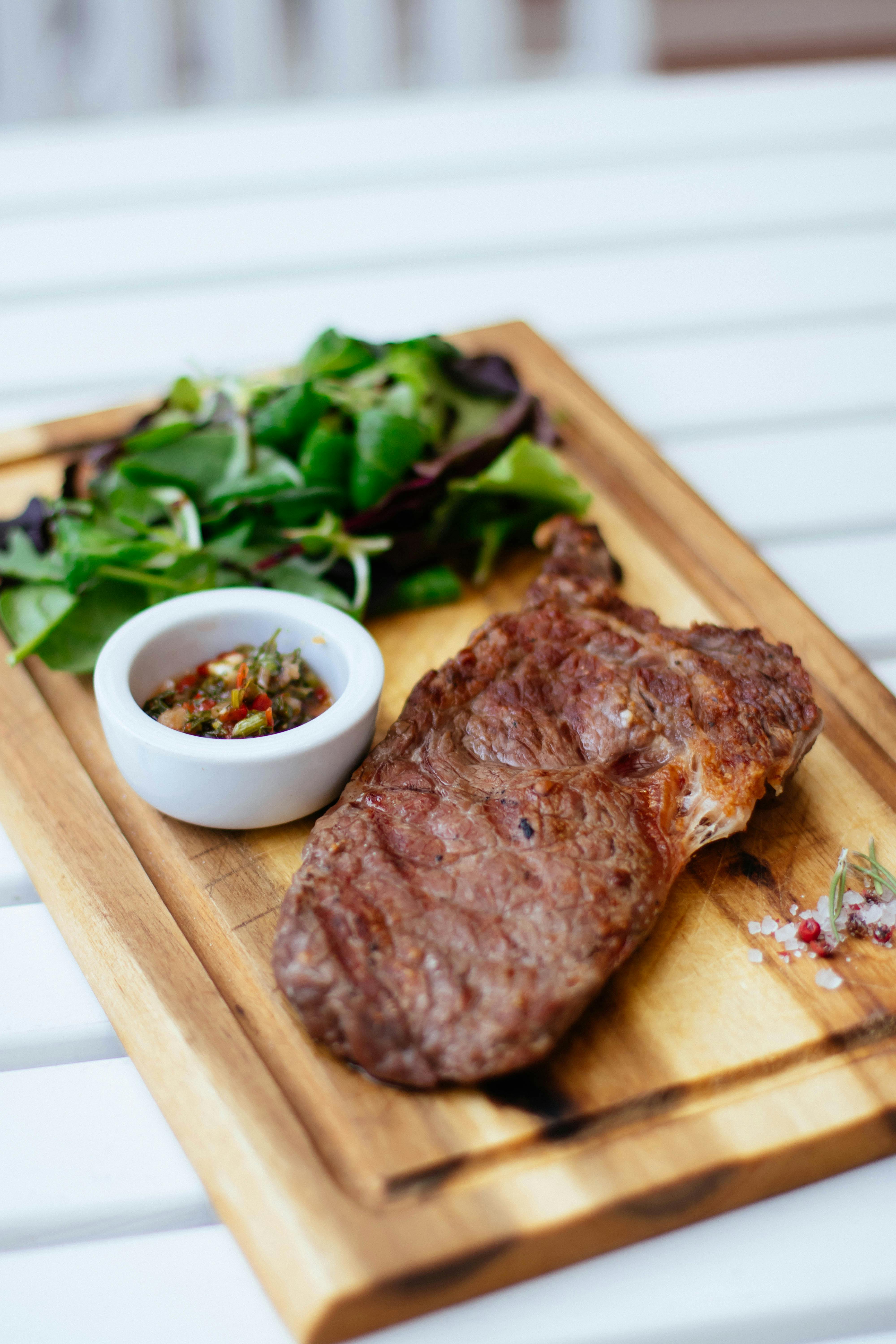
How to Train Your Palate for Medium-Rare Evaluation
You can develop this skill at home. Buy two identical steaks. Cook one to 125°F (rare), one to 135°F (medium-rare), and one to 145°F (medium). Taste them side by side. Notice how the rare steak is chewy and tastes metallic. Notice how the medium steak is drier and the flavor is muted. Notice how the medium-rare steak balances tenderness, juiciness, and beefy flavor. That’s your baseline. Now you know what to expect. When a restaurant delivers something different, you’ll recognize it instantly.
I also recommend practicing the finger test. Cook a steak and check the temperature with a thermometer, then press it with your finger. Associate the feel with the number. After a dozen steaks, you’ll be able to estimate doneness within 5°F by touch alone. It’s a party trick that also saves you from bad steakhouse experiences.
FAQ: Medium-Rare Steakhouse Evaluation
Is it rude to check my steak’s temperature at a restaurant?
Not if you’re discreet. I use a slim probe and check quickly, at my table, without fanfare. If a server asks, I explain that I’m a meat scientist and this is my version of a wine tasting note. Most are curious, not offended. If a restaurant is offended by a customer caring about accuracy, that’s a data point in itself.
What if the steak is slightly under or over—should I always send it back?
I use a 5°F tolerance. If I ordered medium-rare and the center is 128°F, I’ll let it rest another minute and recheck. If it’s 126°F, I’ll ask for a quick finish. If it’s 140°F, I’ll send it back. Life’s too short for overdone steak. But I’m polite about it. The goal is a better steak, not a confrontation.
Can a steakhouse be great even if they mess up my medium-rare once?
Yes, if they recover well. A single misfire is human error. A pattern of misfires is a system failure. I judge a steakhouse on how they handle the mistake. A fresh steak, a genuine apology, and a visit from the chef earn my respect and my return business. Defensiveness or a reheated steak loses me forever.
Does the cut of beef affect the ideal medium-rare temperature?
Yes. Lean cuts like filet mignon are best at 130–132°F because they have little fat to render. Highly marbled cuts like ribeye benefit from 133–135°F to soften the intramuscular fat. A great steakhouse adjusts their target based on the cut. A mediocre one cooks everything to the same number.
Why do so many steakhouses overcook medium-rare?
Because many customers complain when they see pink. Kitchens learn to cook “up” to avoid send-backs. It’s a defensive practice that ruins steaks for people who actually want medium-rare. The best steakhouses educate their customers instead of pandering to misconceptions.
Why Your Instant-Read Thermometer Is the Most Important Tool in the Kitchen
The Cold, Hard Truth About Your Steak
I’ve watched dinner guests cut into a magnificent ribeye and stare at a gray, overcooked interior. Their faces fall. The knife saws back and forth. Somewhere, a cow weeps silently. This tragedy repeats itself in kitchens across America because home cooks refuse to accept a simple fact: your eyes, your timer, and your intuition are lying to you. Only one instrument tells the truth, and it costs less than a mediocre bottle of bourbon.
An instant-read thermometer doesn’t guess. It doesn’t care about your feelings or the recipe’s suggested cooking time. It measures the actual internal temperature of your food with a precision that borders on insulting. After twenty-three years of clinical practice and at least as many years of cooking meat over fire, I’ve learned that data beats dogma every time. A thermometer gives you data. Everything else is just noise.
The 12-Degree Window of Edibility
Consider a beef steak. The range between rare and medium-well spans roughly 120°F to 150°F. That’s 30 degrees of separation, but the sweet spot most people actually enjoy—medium-rare to medium—occupies a narrow band from 130°F to 140°F. Ten degrees. Miss it by a few degrees on either side and you’ve ruined a piece of meat that cost you $18 per pound. Your oven’s temperature dial isn’t calibrated to that level of accuracy. Neither is the palm of your hand, despite what the old-timers at the butcher counter tell you.
I tested the palm method once, purely for scientific curiosity. A raw steak pressed against the fleshy base of my thumb supposedly mimics the feel of a medium-rare steak. The problem is that my hand feels different at 6 a.m. than it does after two fingers of whiskey. My wife’s hand feels completely different from mine. The method is subjective, irreproducible, and frankly absurd. My Thermapen, in contrast, reads 130.0°F every single time. It has no ego.
Carryover Cooking: The Ghost in the Machine
Here’s where the amateurs get tripped up. You pull a roast out of the oven when the center reads 135°F. You let it rest, feeling smug. Ten minutes later you slice it open and discover it’s now 148°F and bone-dry. What happened? Thermal inertia. The outer layers of the meat are hotter than the core; heat continues migrating inward even after the food leaves the heat source. This is carryover cooking, and it can add 5 to 15 degrees to your final temperature depending on the mass of the protein and the cooking temperature.
An instant-read thermometer lets you account for this phenomenon with clinical precision. For a 2-inch-thick steak cooked over high heat, I pull it at 118°F for rare, 125°F for medium-rare. The residual heat pushes it exactly to the target during the rest. Without a thermometer, you’re guessing how much thermal energy remains in the system. I don’t guess. I measure.
Poultry: A Public Health Intervention
Chicken is not steak. The USDA recommends cooking poultry to 165°F to eliminate Salmonella and Campylobacter. At 165°F, the bacteria die instantly. But here’s the nuance the government bulletins don’t advertise: pasteurization is a function of both temperature and time. Chicken held at 155°F for 49 seconds achieves the same bacterial lethality as chicken flash-heated to 165°F. The meat stays juicier at the lower temperature. You can only exploit this fact if you have a thermometer accurate to within a degree or two.
I cook chicken breasts to 150°F and hold them there for three minutes. My thermometer confirms the reading. My dinner guests remain unafflicted by gastrointestinal distress. My chicken doesn’t taste like chalk. Everyone wins. This is not a gamble; it’s applied microbiology backed by a $30 instrument.
The Candy and Oil Problem
Thermometers aren’t just for meat. Try making caramel without one. Sugar syrup passes through thread stage (230°F), soft ball (240°F), firm ball (245°F), hard ball (250°F), soft crack (270°F), and hard crack (300°F) on its way to caramel. The difference between a perfect chewy caramel and a shattered mess is about ten degrees. A candy thermometer or a high-range instant-read gives you that precision. The same applies to deep frying. Oil at 350°F produces crisp, non-greasy food. Oil at 325°F makes everything soggy. Oil at 400°F is a fire hazard. I want to know the exact temperature before the first battered pickle hits the pot.
Thermometer Types: A Brief Diagnostic
Not all thermometers are equal. I classify them into three categories:
- Bimetal dial thermometers: Slow, inaccurate, and prone to calibration drift. The kind your grandfather stabbed into the Thanksgiving turkey. Useful only as a prop in Norman Rockwell paintings.
- Digital fork thermometers: Combine a fork with a sensor in the tines. Better than nothing, but the probes are thick, the readings take 10-15 seconds, and you can’t easily check multiple spots. I find them clumsy.
- Thermocouple instant-reads: The gold standard. A thin-tip probe reads in 2-3 seconds. The sensor is in the very tip, so you can check the exact thermal center of a cutlet without puncturing through to the pan. This is what I use. This is what you should use.
Calibration: Trust but Verify
Even a good thermometer can drift over time. I test mine monthly using an ice bath. Fill a glass with crushed ice, add water until it’s slushy, stir, and insert the probe. It should read 32.0°F (0.0°C). If it reads 34°F, your steaks will be two degrees overdone relative to your target. That might not sound like much, but recall the 10-degree window for medium-rare. A 2-degree error consumes 20% of your margin. Some thermometers have a calibration nut under the dial; digital models may need to be replaced. A $25 tool that prevents me from ruining a $50 ribeye is an investment with an immediate return.

The Resting Period: A Thermodynamic Interlude
Everyone says to rest meat after cooking. Few people explain why in terms that make physical sense. Muscle fibers contract when heated, squeezing moisture toward the center. If you slice immediately, that moisture—which is under pressure—rushes out onto the cutting board. Let the meat rest, and the fibers relax slightly, redistributing the liquid more evenly. The temperature drops a few degrees during this process, which is why the carryover cooking calculation matters. I rest steaks for 5 minutes, roasts for 15-20. I confirm the final internal temperature before carving. It’s a ritual, but a rational one.
Common Objections I’ve Heard (and Dismissed)
“Poking holes lets the juices out.” A thermocouple probe has a diameter of about 1.5 millimeters. The puncture seals almost instantly. The juice loss is immeasurable, especially compared to the torrent you’ll release by slicing into an under-rested, overcooked steak. This objection is emotional, not physical.
“I can tell by touch.” No, you can’t. Not consistently. The blindfold test has humbled many a line cook. I’ve seen chefs with decades of experience miss by 8 degrees. They’re cooking for volume, not precision, and they accept a certain error rate. I don’t.
“It’s one more gadget to clutter the drawer.” It’s the size of a pen. It’s the one gadget that pays for itself within two meals. If your kitchen drawer is too cluttered, throw out the avocado slicer.
Beyond Meat: Bread, Custard, and Other Vulnerable Substances
Yeast breads finish baking when the internal temperature hits 190-200°F. Enriched doughs like brioche are done around 190°F. A thermometer probe inserted into the center of a loaf gives you a definitive answer instead of the hollow-thump nonsense that works only on specific bread shapes. Custards and ice cream bases curdle above 180°F; a thermometer keeps you safely in the 170-175°F range where the proteins thicken without scrambling. I use my Thermapen to check the temperature of melted chocolate during tempering, the doneness of baked potatoes (210°F), and the warmth of baby formula when my children were infants. The tool migrates across the kitchen because temperature is the fundamental variable in almost every cooking process.
The Psychology of Certainty
There’s a deeper reason I advocate for thermometers. Cooking is stressful enough without ambiguity. When you know the internal temperature of your roast is exactly 133°F, you can pour a glass of wine and talk to your guests without anxiety. You’re not hovering over the oven, second-guessing the timer, poking the meat with a worried finger. The thermometer has given you a data point. The rest is just waiting. That confidence translates to better meals and more pleasant dinner parties. Uncertainty is the enemy of hospitality.
Selecting a Thermometer: My Clinical Criteria
When a colleague asks which instant-read to buy, I give them a short checklist. The probe must be thin-tipped—no more than 1.5mm at the point. The read time should be under 3 seconds. The display must be backlit and rotate automatically for left-handed use. The temperature range should span at least -58°F to 572°F to cover frozen foods and hot sugar work. Water resistance matters because kitchen accidents happen. I won’t endorse a specific brand here, but I will say that the market leaders earn their reputation through thermocouple accuracy and durability. Spend $80-$100 once, or spend $15 repeatedly on junk that drifts. This is not a place for false economy.
Frequently Asked Questions
Can I leave an instant-read thermometer in the meat while it cooks?
No. Instant-read thermometers are not designed to stay in the oven or on the grill. The plastic housing and electronic components will melt or fail. For continuous monitoring, use a leave-in probe thermometer with a heat-resistant cable and an external display. I use both: the leave-in probe tracks the roast’s progress, and I verify the final temperature with the instant-read in multiple spots.
Where exactly do I insert the probe for an accurate reading?
Insert the tip into the thickest part of the meat, avoiding bone, fat pockets, and the cooking surface. Bone conducts heat faster than muscle and will give a falsely high reading. For thin cuts like chicken breasts or burger patties, insert the probe horizontally through the side to reach the thermal center. Take readings in two or three spots; if they differ by more than a couple degrees, the meat hasn’t finished carryover cooking or your heat source is uneven.
How do I clean and maintain a digital thermometer?
Wipe the probe with a damp cloth and a mild detergent after each use. Avoid submerging the entire unit unless it’s rated IP67 or higher. The probe tip is the business end; keep it free of carbonized grease, which insulates the sensor and slows response time. If the readings drift, test in an ice bath. Some models have a recalibration procedure; consult the manual. Replace the batteries annually regardless of use—a weak battery can cause erratic readings.
Is a meat thermometer really necessary for ground beef burgers?
Ground beef carries a higher contamination risk than whole-muscle cuts because surface bacteria get mixed throughout the meat. The USDA recommends cooking ground beef to 160°F. I cook my burgers to 135-140°F only if I’ve ground the meat myself from a whole cut moments before cooking. Even then, I probe every patty. With pre-ground supermarket beef, I hit 160°F and accept a slightly firmer texture. A thermometer lets you make that risk calculation consciously rather than blindly.
Closing Argument
Here’s the thing. I’m a man of routine. Every evening I cook, I pull the Thermapen from its sheath, unfold the probe, and take a reading. The beep confirms that physics hasn’t changed since yesterday. The steak comes off the grill at the temperature I chose, not the temperature chance imposed. My guests eat meat that is precisely as done as they requested. They compliment the cook. I nod and say something about the quality of the beef, but I know the truth: the thermometer did the heavy lifting. I just held the tongs.
If you cook with any regularity, buy one. Learn to trust the number. Your steaks, your chickens, your custards, and your dinner guests will all be better for it. And the next time someone tells you they can judge doneness by the color of the juices or the springiness of the flesh, just smile and pass them the thermometer. They’ll figure it out eventually.
The Cold, Hard Truth: Why Your Instant-Read Thermometer Is the Only Adult in Your Kitchen
I’ll start with a confession. I once ruined a $47 ribeye. Not by ignoring it, not because the grill was acting up, but through pure, unfiltered guesswork. I poked the flesh with my finger, did the whole palm-test charade, and announced medium-rare. The internal temperature—had I bothered to look—was 152°F. That’s not medium-rare. That’s a crime scene of seized protein and lost moisture. The dog ate well. My soul did not. That night branded a lesson into me deeper than any sear I’ve ever managed: an instant-read thermometer isn’t a nice-to-have. It’s the lone adult standing between you and total kitchen chaos.
I’m Dr. Mike Harmon, and my kitchen operates on data. Not feelings. Not the springiness of a steak. Not juice color. A number. A cold, unblinking digital number. This tool—often cheaper than one decent steak—separates a cook who hopes from a cook who knows. And when you’re staring down expensive ingredients and hungry guests, hope is a lousy plan.
The Palm Test: A Folklore Autopsy
Before we celebrate the fix, we need to bury the problem properly. The palm test—pressing the fleshy base of your thumb to judge doneness—is the flat-earth theory of cooking. It hangs on despite all evidence. The idea: a relaxed hand feels like rare, thumb to index finger is medium-rare, and so on down the line. The fatal flaw? My hand isn’t your hand. My hand today, after hauling a cooler packed with ice and brisket, isn’t my hand tomorrow. A line cook’s calloused mitt isn’t a home cook’s keyboard-softened palm. The test is subjective, unrepeatable, and scientifically empty. I ran the experiment. With my own hand relaxed, I pressed a steak sitting at exactly 130°F. It felt, to my calibrated finger, like medium-rare. The same hand, after gripping a cast-iron handle for ten seconds, declared a 145°F steak rare. The palm test is a lie your uncle told you, and it’s time we stopped repeating it.
Then there’s the fork-poke-and-juice-check routine. Myoglobin—the protein behind that red liquid—shifts color with oxygen exposure, not just heat. A steak resting ten minutes weeps a darker juice than one sliced immediately, even if both are exactly 135°F. Visual cues are chemical illusions. Trusting them is like navigating by watching clouds drift.
The Physics of Protein: Why 5°F Matters More Than Your Opinion
Meat is a scaffold of proteins, water, and fat. Heat denatures proteins—unravels their tightly wound structures—and this isn’t a gentle slide. It happens in distinct temperature bands. Myosin, the protein that handles muscle contraction, starts to denature around 104°F and is mostly done by 122°F. That’s why a rare steak (120–125°F) still feels soft. Actin, the other major player, doesn’t begin serious denaturation until about 150°F. Between 130°F and 140°F, you’re in the sweet spot: myosin has relaxed, loosening its grip on water, but actin is still largely intact. The steak is tender and juicy. Push past 150°F, and actin tightens hard, wringing moisture out like a fist around a sponge. The gap between 135°F and 155°F isn’t 20 degrees. It’s the gap between a steak and a hockey puck.
This isn’t culinary opinion. It’s biochemistry. And the only way to steer through these narrow, unforgiving bands is with a thermometer that responds in two or three seconds. Not a dial thermometer that lumbers toward accuracy like a drunk toward a lamppost. An instant-read. A Thermapen, a ThermoPop, or any reputable digital model with a thin-tip thermocouple. The thin tip matters. It makes a smaller wound in the meat—less juice loss—and it reads temperature right at the very tip, not averaged over a half-inch zone like those old-fashioned dial probes.
Calibration: Trust, But Verify
Even a good thermometer can drift. I check mine every month, and you should too. The method is almost insultingly simple: fill a glass with heavily iced water, stir, let it sit a minute. That slurry sits at 32°F (0°C). Insert your probe. If it reads 32°F, you’re in business. If it reads 35°F, your medium-rare is actually medium. A 3-degree error compounds straight into disappointment. Most digital thermometers can be recalibrated—a small potentiometer under the battery cover or a hold-this-button-while-turning-it-on sequence. Read your manual. If you lost it, the internet remembers. If your thermometer can’t be calibrated, throw it into the sea. It’s a random number generator, not an instrument.

Carryover Cooking: The Ghost Heat
Here’s where even thermometer owners stumble. You pull a steak at 130°F, aiming for medium-rare. Five minutes later, it’s 138°F and firmly medium. You curse the thermometer. The thermometer is innocent. The culprit is carryover cooking—residual heat from the steak’s exterior still migrating inward after it leaves the pan. The bigger the thermal gradient (the difference between a screaming-hot surface and the cool center), the more pronounced the carryover. A steak seared in a 600°F cast-iron pan can climb 10–15°F during rest. A gently reverse-seared steak might only climb 5°F.
My rule, born of measuring this over and over: for high-heat seared steaks, pull them 10°F below your target final temperature. For a medium-rare finish of 130–135°F, I pull at 120–125°F. For reverse-sear, I pull from the low oven at 115°F, sear 60 seconds per side, and the final reading after a brief rest lands at 128–132°F with unnerving consistency. The thermometer isn’t just for the finish; it’s for the pull. It’s for the rest. It’s for the moment you realize you’ve been overcooking chicken your entire life.
Chicken: The Fear-Based Protein
People mistreat chicken. They cook it until the breast hits 175°F because they’re afraid of dying. I get the fear. Salmonella is real. But the USDA’s old 165°F guideline is an instantaneous kill temperature for bacteria. What they don’t emphasize enough is the time–temperature curve. At 155°F, salmonella is killed in just under a minute. If your chicken breast holds 155°F for 60 seconds—which it will, easily, during a normal rest—it’s exactly as safe as chicken cooked to 165°F. And it will be dramatically juicier. I cook chicken breast to 150°F and hold it there for 3 minutes. The texture is a revelation. The safety is identical. The only way to do this with confidence is with an instant-read thermometer you trust. Guessing is not an option when the stakes are gastrointestinal.
Dark meat is a different animal. Thighs and drumsticks carry more connective tissue and fat. Collagen starts breaking down into gelatin around 160°F, but the process really picks up speed at 175°F and above. I cook thighs to 175–180°F, not for safety, but for texture. At 165°F, a thigh is safe but chewy. At 180°F, it’s silky. The thermometer tells you which world you’re standing in.
Fish: The Delicate Window
Fish proteins denature at lower temperatures than land animals. Most fish are perfectly cooked at 120–130°F. Salmon, my frequent subject, is sublime at 125°F—the flesh just set, the albumin (that white stuff) not violently squeezed out, the texture almost custardy. At 140°F, salmon is dry and chalky. The window is narrow. A Thermapen is the only way to hit it reliably. For tuna, I want 105°F in the center—warm but still essentially raw. You can’t guess that. You can’t poke it and know. You need the number.

Beyond Meat: Sugar, Bread, and the Maillard Conspiracy
Your instant-read thermometer isn’t a one-trick pony. It’s a general-purpose probe for the physical world. Making caramel? The difference between a light amber caramel (340°F) and a bitter, burnt mess (360°F) is about 90 seconds of inattention. A thermometer clipped to the pot gives you a countdown. Frying doughnuts? Oil at 350°F yields a crisp shell and a fully cooked interior. Oil at 325°F gives you a greasy sponge. Oil at 400°F gives you a carbonized exterior and raw dough. I don’t deep-fry without a thermometer. Neither should you.
Baking bread? The internal temperature of a fully baked lean dough loaf is 190–200°F. Enriched doughs, like brioche, finish around 190°F. The thump-on-the-bottom test is acoustic guesswork. The thermometer is a window into the crumb. I’ve pulled loaves that sounded hollow and read 180°F inside—underbaked, gummy, destined for the compost. The thermometer doesn’t lie. The thump does.
The Resting Lie: Why Your Steak Is Not Actually Resting
Conventional wisdom says rest your steak 5–10 minutes. I say monitor your steak during rest. The internal temperature will keep climbing for a while, then plateau, then start to fall. The moment it begins to fall is the moment the muscle fibers have relaxed enough to stop squeezing moisture out. That’s the true moment to slice. For a thick-cut ribeye, this might be 7 minutes. For a thin flank steak, it might be 3 minutes. The thermometer tells you when the thermal coasting has ended. Slice before that, and you’ll watch a pool of myoglobin-water spread across your cutting board, carrying flavor away from the meat. Slice after the temperature starts dropping, and the juices stay in the fibers. This isn’t mysticism. It’s observable, measurable, and repeatable.
Thermometer Technique: The Angle of Truth
How you insert the probe matters. You want the tip in the thermal center of the thickest part of the meat, avoiding bone, fat pockets, and the pan itself. For a steak, come in from the side, parallel to the cooking surface, so the entire probe shaft is buried in the meat. This keeps the probe from acting as a heat sink, conducting hot surface air into the cooler center and giving a falsely high reading. For a chicken breast, insert through the thickest part horizontally. For a roast, go straight down into the center, but pull it back slowly—you’ll often find a cooler zone an inch above where you first stopped. The lowest reading in that slow withdrawal is your true core temperature. This is the “lowest reading wins” rule. It has saved more dinners than I can count.
FAQ: Your Thermometer Anxieties, Addressed
Do I really need an instant-read thermometer if I only cook a few times a week?
Yes. In fact, you need it more. Professional cooks develop an intuitive sense of doneness through sheer repetition—hundreds of steaks a night. You cook a steak once a week, maybe twice. Your intuition is statistically insignificant. The thermometer is your externalized intuition. It costs less than the steak you’re about to ruin. Buy one.
Can’t I just use the built-in probe on my oven or smoker?
You can, but you shouldn’t trust it exclusively. Built-in probes are often inaccurate by 5–15°F, and they measure only one spot. I’ve seen oven probes read 135°F while the true core of the meat was 118°F. Use the built-in probe as a rough guide, but always verify with an instant-read before pulling. The built-in probe is the intern. The instant-read is the attending physician.
What temperature should I cook my steak to?
This is the only question that matters, so here is the definitive Dr. Mike chart, based on final rested temperature:
Rare: 120–125°F. Cool, red center. Minimal protein denaturation.
Medium-Rare: 130–135°F. Warm, red center. Myosin denatured, actin intact. The sweet spot.
Medium: 140–145°F. Pink, firmer. Actin begins to tighten. Juice loss accelerates.
Medium-Well: 150–155°F. Slightly pink, significantly drier. I cannot recommend this.
Well-Done: 160°F+. Gray, tough. You have denatured everything. The steak is dead. Serve with ketchup, I suppose.
The Only Kitchen Tool That Pays for Itself
Consider the economics. A quality instant-read thermometer costs between $30 and $100. A prime dry-aged ribeye costs $40 to $60. Ruining one such steak wastes more money than the tool that would have saved it. Over a year of cooking, a thermometer prevents enough overcooked chicken, desiccated pork chops, and collapsed cakes to pay for itself several times over. It’s not an expense. It’s an insurance policy with a 1000% annual return.
But the real value isn’t financial. It’s the elimination of anxiety. The moment you insert that probe and see 130.0°F, you’re no longer guessing. You’re certain. You can plate that steak with the calm confidence of a surgeon who knows the tumor is benign. Your guests will notice. Not the thermometer—they’ll never see it if you probe from the side—but the consistency. The perfect medium-rare, every time, regardless of steak thickness, grill temperature, or the weather outside. That consistency is what separates a cook from a chef. The thermometer is the bridge.
So here’s my prescription. Buy an instant-read digital thermometer with a thin-tip probe. Calibrate it monthly. Use it on everything: steak, chicken, fish, bread, sugar, oil. Pull your proteins early, accounting for carryover. Rest them until the temperature stops rising. And never, ever trust the palm test again. Your hand is a liar. Your thermometer is the truth.