The Numbers Behind the Plate
You know that feeling when you bite into something extraordinary and wonder how they do it for the price? I used to feel that magic was pure skill and love, and while those absolutely matter, I’ve come to realize there’s a whole economic infrastructure humming beneath every plate that leaves your table. The restaurant industry in the United States pulled in about 1.1 trillion dollars in revenue during 2025, which sounds enormous until you understand what actually stays in the restaurant’s pocket.

Here’s where the real story gets interesting: after all the expenses pile up, most restaurants are working with a profit margin somewhere between 3 and 9 percent. Let that sink in. When you spend 50 dollars on dinner, the restaurant might be keeping between 1.50 and 4.50 dollars from that transaction before they pay taxes. Everything else goes to rent, ingredients, labor, utilities, permits, insurance, and a thousand other hidden costs. It’s a game of razor-thin margins where a particularly expensive delivery of olive oil or a week of slower-than-expected traffic can swing the whole month.

The Tipping Dilemma: A System Under Pressure
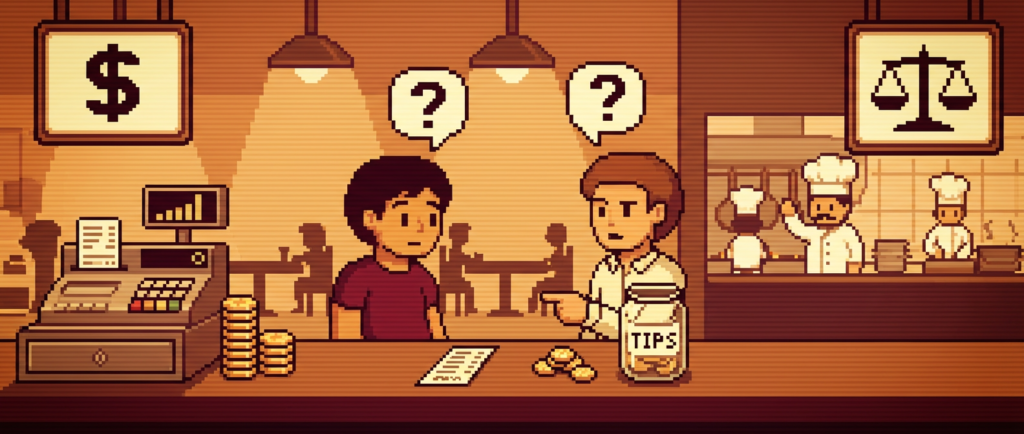
Now let’s talk about something that’s clearly weighing on everyone’s mind because the evidence keeps piling up: tipping culture has reached an inflection point. About three-quarters of diners report feeling genuinely pressured when faced with tip screens at casual restaurants, coffee shops, and takeout counters. That’s not a small number. That’s not a fringe complaint. That’s three out of four people feeling an uncomfortable squeeze between social obligation and personal budget.
The tension exists because the system was never really designed for this. Tipping in America emerged as a way to supplement service staff wages in a specific context: fine dining establishments where customers were already paying premium prices and servers provided exceptional service over the course of an evening. But somewhere along the way, tipping screens appeared everywhere. They showed up at self-checkout counters, at grab-and-go bakeries, at pizza counters where no one actually served you. What started as a tool for rewarding excellence became a confusing, low-grade tax on every transaction.
Restaurants themselves are caught in this trap. They want to pay their staff fairly, and they know that tips have historically been the mechanism for doing so. But they also understand that customers are exhausted by it. It’s a genuine bind without an easy resolution, which is why some establishments are experimenting with a completely different approach.
The Service-Included Model: A New Blueprint Emerging
In several major coastal cities, a different model is gaining real traction. Some restaurants are moving toward service-included pricing, which means the gratuity is built into the menu prices rather than added at the end. You see one number, you pay that number, everyone knows where they stand. The economics work because the restaurant calculates what they need to pay staff fairly, adds that into the menu price, and eliminates the awkward moment entirely.
This approach requires some mathematical finesse. A restaurant needs to figure out how much their staff needs to earn, how many covers they serve during a typical service, and what portion of the bill should flow toward labor costs. It’s the kind of thing that makes restaurant owners sit down with spreadsheets and calculators, running scenarios like a chess player thinking three moves ahead. But when it works, something interesting happens: customers feel more honest about what they’re paying, staff feels more secure, and there’s less of that emotional labor around the check.
That said, this model hasn’t swept the industry. Many restaurants remain tethered to the traditional tipping system because it’s what customers expect, what they’re trained to navigate, and what the actual economics of thin margins seem to require. Changing that system means changing customer expectations across an entire region or city, which is a monumental task.
The Hidden Tax of Delivery Platforms and Ghost Kitchens
Let me tell you about another economic pressure that’s been quietly reshaping the restaurant landscape. Those delivery platforms that make food appear at your door within thirty minutes? They take somewhere between 25 and 35 percent of each order value. That’s not a small transaction fee. That’s a commission that fundamentally changes the math of whether a restaurant can afford to operate through these channels.
For years, restaurants went along with this because the platforms promised access to customers they couldn’t reach otherwise. But when you do the math backwards from your tight 3 to 9 percent margin, handing over 30 percent for delivery creates an impossible equation. Some restaurants responded by creating what became known as ghost kitchens during the pandemic: delivery-only operations without dining rooms, designed to cut overhead and serve this channel exclusively. The concept was supposed to be the future of food delivery. But as the pandemic faded and delivery demand normalized, many ghost kitchens quietly shut down. The model wasn’t as resilient as it first appeared.
For a deeper understanding of how these economic forces are reshaping food culture, Eater food culture covers these stories with real depth and reporting. And if you want the industry’s perspective on these challenges, the National Restaurant Association regularly publishes data about where restaurants are struggling.
What This Means for Your Favorite Place
When you sit down at a restaurant you love, you’re participating in an economic system that’s more fragile than it appears. The chef who remembers your preferences, the server who anticipates what you need before you ask, the owner who sources from local farms even though it costs more: these are people working within constraints that would surprise most diners. They’re not keeping much of what you spend. They’re trying to do something meaningful while staying solvent.
Understanding this doesn’t solve the tipping dilemma or make platform commissions disappear. But it does change how I think about these conversations. The problem isn’t that individual servers or restaurants are greedy. The problem is structural. It’s a system designed around assumptions that no longer hold true, and we’re all trying to navigate it honestly while also trying to eat, work, and keep businesses alive.
I’m genuinely curious about how you’ve been experiencing these shifts. Are you noticing different tipping situations? Have you encountered restaurants with service-included pricing? Have you tried ghost kitchen delivery and formed opinions about the model? The restaurant economy is changing in real time, and these shifts ultimately affect what we can eat, where we can eat it, and who gets to stay in this industry they love. Tell me what you’re seeing in your neighborhood.